Specimen of Peacock Nymphalis

Specimen of Peacock Nymphalis

It is a medium-sized butterfly common in temperate regions of Europe and Asia. The base color of the wings is rusty red, and there are black, blue and yellow eye-like spots on the wing ends. These eye-like marks are their most prominent feature. The wings are dark brown or black on the opposite side, with a good concealment color. The larvae feed mainly on urticaceae plants, while the adults feed on nectar, sap and decaying fruit. It plays an important ecological role in nature and is an important part of the ecosystem in many areas. The eye markings on the wings suddenly unfold when they encounter a predator, and this bluff can often scare off predators and protect themselves from attack.
Specimen of Dahuang Butterfly

Specimen of Dahuang Butterfly

It is a medium-sized gray-brown butterfly. It is a typical peat and wet wasteland species. Its distribution range starts from northern England and Ireland, and extends eastward through France and Slovakia to most of Scandinavia. The adult flight period is usually between June and August, feeding on cruciferous plants. Males and females are similar in appearance, but females are slightly lighter in color. The eye spot on the underside varies with latitude, with few spots in northern Scotland and bright and sharply colored spots in England. Usually does not spread its wings to bask in the sun and likes to fly in gloomy weather, as long as the temperature is warm enough.
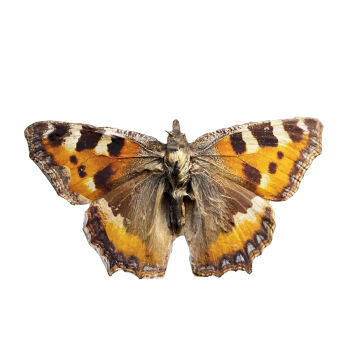
Nymphalid specimen of nettle

Nymphalid specimen of nettle

Also known as the small tortoiseshell butterfly, it is a butterfly widely distributed in Europe and parts of Asia. It feeds on plants of the Urticaceae family, hence its name. The wings are usually yellow and black markings, which are highly recognizable. The larvae feed on plants of the family Urticaceae, such as nettle and hemp. Survive in a wide variety of habitats. The adults hibernate in winter in March or April and are one of the first butterflies seen each spring. Females lay eggs in batches under the leaves of food. After about 10 days the eggs hatch and the caterpillars live in the silkscreen protection of the colony. The pupa is suspended from a plant stem or other object. Adult worms appear about two weeks later.
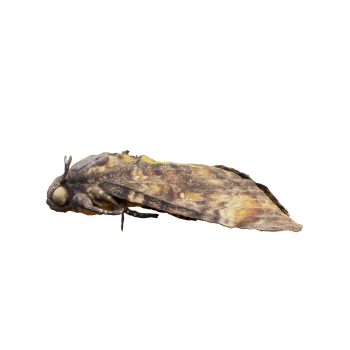
Dead Head Hawk Moth Specimen

Dead Head Hawk Moth Specimen

is a large nocturnal moth known for its distinctive skull-like markings on the back of its chest. Widely distributed in parts of Africa, Europe and Asia. The body color varies from dark brown to yellow, but the most prominent feature is the skull-like pattern on its chest. The adults feed on the nectar of a variety of plants and sometimes enter the hive to steal honey. The larvae feed mainly on the alkaloid-containing plant leaves. It is active between dusk and midnight, is phototropic, and has a variable and unpredictable flight pattern. Male moths emit high-frequency squeals during courtship, a defense mechanism created by inhaling and expelling air.
Specimen of moth (brown spotted variant)

Specimen of moth (brown spotted variant)

is a black variety of the spotted moth, known for its adaptive changes during the Industrial Revolution. Originally, this moth was white in color with black spots and was suitable for perching on unspoiled trees. However, with the advancement of industrialization, environmental pollution has caused the trunk to turn black, and the original white moth has become conspicuous in this environment, thus being threatened by predators. In the 19th century, as pollution increased, the number of carbon-colored varieties increased rapidly, especially in industrial areas. The phenomenon, dubbed "industrial blackening," has become a classic case of natural selection showing how species adapt to survive changes in their environment.
Specimen of moth (Carbophora)

Specimen of moth (Carbophora)

is a black variety of the spotted moth, known for its adaptive changes during the Industrial Revolution. Originally, this moth was white in color with black spots and was suitable for perching on unspoiled trees. However, with the advancement of industrialization, environmental pollution has caused the trunk to turn black, and the original white moth has become conspicuous in this environment, thus being threatened by predators. In the 19th century, as pollution increased, the number of carbon-colored varieties increased rapidly, especially in industrial areas. The phenomenon, dubbed "industrial blackening," has become a classic case of natural selection showing how species adapt to survive changes in their environment.
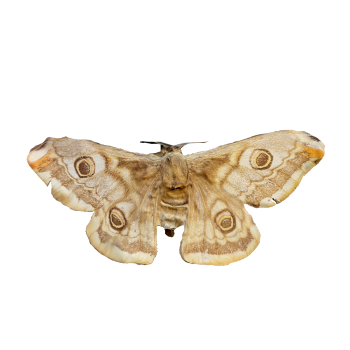
Monarch Moth Specimen

Monarch Moth Specimen

Also known as Sapium silkworm moth, is a huge moth, is one of the largest moths in the world. It is mainly found in the tropical and subtropical rainforests of Southeast Asia. The color of the wings is auburn, with a unique snake-head pattern, and the two black round spots at the tip of the wings are like snake eyes. This mimicry may be used to defend against natural enemies. It is nocturnal and feeds on the leaves of trees, especially the tallow tree, hence its name. The larval period will be spent in a cocoon with an extremely narrow opening, and the wings must be spread through the narrow cocoon hole, which helps their wings become bloodshot and ready for flight. Adulthood has a short lifespan, does not feed, and mainly mates and lays eggs.
red butterfly specimen

red butterfly specimen

It is a widely distributed butterfly belonging to the family Nymphalidae. The wing span is about 5-6cm, and the adult wings are black, with distinct red bands and white spots on the forewings and red and black markings on the margins of the hindwings. It is distributed in North America, Europe, Asia and North Africa, usually inhabiting humid forests, gardens and fields. The larvae feed on the leaves of plants such as nettles. The adults are active in spring and summer, feed mainly on nectar, and especially like the flowers of Asteraceae. The butterflies are known for their migratory behavior, moving from the warm southern regions to the north in the spring and back in the fall.
large cabbage butterfly specimen

large cabbage butterfly specimen

Also known as the European pink butterfly, is a medium-sized pink butterfly, belonging to the pink butterfly family. It is mainly milky white, with black spots at the base of the male front wing and along the rib vein, black at the tip and end of the second wing vein, black at the base of the hind wing, and a large black spot in front of the tip. Farming lands, grasslands and parks from Europe, North Africa and Asia to the Himalayas can fly far away, as European communities have migrated to the UK in recent years. Caterpillars are yellow-green, with yellow lines and black spots, and eat in groups on the leaves. The adult is active during the day, especially on sunny days, and often sucks nectar in the flowers. It is considered an important agricultural pest.
Specimen of Grassland Brown Butterfly

Specimen of Grassland Brown Butterfly

It is a species of butterfly in the family Lepidoptera. It occurs in large numbers in the summer on the grasslands of the United States and Europe. The larvae are velvety brown or green, with small, forked caudal appendages. Adult butterflies have brown wings with a wingspan of about 5-6cm. The most prominent feature is the conspicuous spots (ring markings) on the wings. The false eyes on these wings may be used to frighten or confuse predatory birds. A defense mechanism. Adult antennae end gradually thickened, but not obvious; forefoot degeneration, contraction not used. Ecological habits and morphological characteristics make it have a certain protective color in the natural environment, which helps to survive in the grassland environment.
Specimen of large hawksbill butterfly

Specimen of large hawksbill butterfly

Also known as the large turtle-shell butterfly or black-legged turtle-shell butterfly, it is a rare butterfly that is widespread in the forests of continental Europe, North Africa and Central Asia. It is famous for its distinctive yellow and orange colors and black patterns on its wings. The giant hawksbill butterfly has a wingspan of up to 70-90mm and is one of the largest species of giant flash butterfly. It prefers to be active in forested areas and woodland edges, with adults feeding on nectar and larvae feeding on plant leaves. Usually one generation occurs a year, and adults appear from mid-April to the end of October. Because of its beautiful appearance and ecological value, it is often concerned by nature lovers and butterfly collectors.
Dark Veined Cabbage Butterfly Specimen

Dark Veined Cabbage Butterfly Specimen

Also known as the greenbelt pink butterfly, is a medium-sized butterfly belonging to the family Pink Butterfly. The color and markings of adults may vary under different environmental conditions, and individuals grown at high temperatures are usually darker in color and more pronounced in markings. There are two generations in a year, the spring type is in May-June, the summer type is in July-August, and the pupae overwintering. The larvae mainly feed on cruciferous plants, causing some harm to crops. The adults like to move on sunny days, usually sucking honey on flowers, flying slowly, and often perching in the fields or open fields. Mainly distributed in Europe, Asia and North America.
Imperial Purple Butterfly Specimen

Imperial Purple Butterfly Specimen

It is a temperate butterfly mainly distributed in forests of Europe and Asia. Often soaring high on the top of the forest, male butterflies are sometimes attracted to decaying corpses on the ground because they need to absorb minerals from the corpses. Adult butterflies have dark brown wings with white lines and small orange rings on them. Male butterflies have a shiny blue purple luster, while females do not have this luster. The larvae are green in color, with white and yellow spots on them, and have two large antennae. They are larger in size than ordinary butterflies. The surface of its wings is covered with transparent scales, which reflect light to form interference patterns, causing the human eye and brain to perceive it as purple.
Large Blue Butterfly Specimen

Large Blue Butterfly Specimen

It is a butterfly distributed in Europe, known for its unique ecological habits and conservation needs. The adult body length is approximately between 35 and 40 millimeters, with bright blue wings and black and white spots on the edges. The larval stage is very special, and there is a symbiotic relationship with ants. They will spend time in specific ant nests, where ants protect their larvae and provide food. Larvae will mimic the appearance and behavior of ants to gain their acceptance. This unique lifecycle makes the Blue Butterfly very demanding of its habitat, requiring specific plants as a food source and habitat adjacent to ant nests.
Pearl edged butterfly specimen

Pearl edged butterfly specimen

It is a medium-sized butterfly known for its pearl shaped white spots at the bottom of its wings and bright orange wings. It appears very early in spring and can be found in forest clearings or rough slopes with ferns in April. Usually flying near the ground, often stopping to smoke spring flowers such as snowballs. The conservation status of this butterfly is highly valued in the UK, and its population is rapidly declining in the UK and Wales, currently in a highly threatened state. Larvae mainly feed on plants of the Violaceae family and require sufficient food. Plants grow in short and sparse vegetation, with abundant fallen leaves.
Ash Butterfly

Ash Butterfly

Belonging to some small butterfly species in the family Lycaenidae, they are known for their soft gray, white, or brown wings and unique markings. The Grey Butterfly family is one of the largest families of butterflies, widely distributed and diverse worldwide. Larvae mainly feed on the leaves of various plants, while adults feed on nectar. Plays an important role in the ecosystem as a pollinator, promoting plant reproduction, and also serves as a food source for many bird and other insect predators. Eggs are usually laid on the leaves of the host plant. After hatching, larvae begin to feed and undergo several molts before entering the pupal stage, eventually emerging into adults.
Uang

Uang

It is an insect of the family Scaridae in the order Beetles, known for its unique appearance and powerful strength. It is particularly common in regions such as China, Japan, and Southeast Asia, and is a popular target for insect enthusiasts and collectors. Large in size, usually black or dark brown, covered with a hard shell. The head has a prominent angular protrusion, which is the origin of its name, while females do not have this feature. Larvae usually live in soil rich in humus and feed on decaying plants. Adults feed on tree sap, fruits, or other decaying substances. Known for its powerful flying ability and strong leg strength.
Orange Pink Butterfly

Orange Pink Butterfly

A butterfly belonging to the family Papilionidae and genus Papiliopsis. Known for its bright orange wings, it is a common species in parts of Europe and Asia. It usually has an orange or orange red base color, and male and female butterflies have slightly different appearances. Female butterflies are usually more brightly colored, while male butterflies have lighter colors. Larvae mainly feed on plants of the Violaceae family, while adults feed on nectar. Flying at a fast speed, it frequently shuttles between flowers while searching for nectar. The activity time is mainly concentrated from late spring to autumn, especially in sunny weather. Eggs are usually laid on the leaves of plants in the family Violaceae. After hatching, larvae feed on the leaves of the plant and eventually pupate and metamorphose into butterflies
Blue Butterfly 3D Model

Blue Butterfly 3D Model

Usually refers to a type of butterfly with bright blue wings, belonging to various families of butterflies. The most famous ones may be the Blue Flash Butterfly and the Blue Grey Butterfly. Wings usually have a metallic blue luster, which is caused by the special structure of the scales on the wings reflecting light, rather than being produced by pigments. They are widely distributed around the world, from tropical rainforests to temperate regions where their presence can be found. Living habits and habitats vary, some prefer to fly on open grasslands, while others prefer forest edges or gardens. Larvae usually feed on plants, while adults feed on nectar.
Flash Butterfly (with 3D Animation Model)

Flash Butterfly (with 3D Animation Model)

It is a beautiful and unique butterfly known for its rapid flight and sparkling wings. It usually has a bright metallic color, and the scales on the wings can reflect light, creating a dazzling shimmering effect. Widely distributed in tropical and subtropical regions, with diverse habitats, they can be found in forests and grasslands. The wings have various shapes, some with sharp edges and others with rounded edges, but they all share a common feature, which is that the patterns and colors on the wings are very charming. These patterns are not only beautiful, but also have important biological significance for the survival of butterflies, such as being used to warn predators that they may be toxic
Red Butterfly (with 3D Animation Model)

Red Butterfly (with 3D Animation Model)

It is a class of colorful and diverse insects belonging to the order Lepidoptera. Known for its beautiful wings and elegant flying posture. The wings are covered with small scales, which not only give them bright colors, but also have a protective effect. The life cycle includes four stages: egg, larva (caterpillar), pupae, and adult. This metamorphosis process is a typical characteristic in entomology. Plays an important role in nature as a pollinator for many plants. It is also a link in the food chain, providing food for birds and other animals. However, due to habitat destruction and environmental pollution, some butterfly species are facing survival threats.
Meishen Shandie (with 3D animated model)

Meishen Shandie (with 3D animated model)

It is a butterfly that lives in the tropical rainforests of South America. Known for its brilliant blue wings, it is the darling of butterfly enthusiasts and nature photographers. The wings will present a gradient color from deep blue to sky blue at different angles, as if they were a work of nature. Large in size, with wings that can spread up to 15 centimeters, it is one of the larger species in the butterfly family. Usually active in the early morning and evening, feeding on nectar. Due to the destruction of its habitat and climate change, the population of the Megalosaurus butterfly has been affected to some extent, therefore protecting its living environment is crucial for maintaining biodiversity.
Tiger spotted butterfly (with 3D animated model)

Tiger spotted butterfly (with 3D animated model)

It is a species of butterfly in the family Nymphalidae and genus Nymphalidae. Known for its unique wing pattern, the wings have distinct black stripes and orange spots that form the origin of its name. Mainly distributed in tropical and subtropical regions of Asia, including India, Southeast Asia, and southern China. The spread of wings is usually between 80 and 100 millimeters, and there is almost no difference in appearance between males and females. Larvae mainly feed on plants of the Malus genus, while adults prefer to feed on nectar. It plays an important role in nature, not only pollinating plants, but also being loved by people for its beautiful appearance.
Housefly (with 3D animated model)

Housefly (with 3D animated model)

It is a completely metamorphosed insect, whose life cycle includes four stages: egg, larva (maggot), pupae, and adult. Adult insects are 5-8 millimeters long, gray brown in color, and have significant identification features, such as four black vertical stripes on the back of the thorax. Living in areas rich in organic matter, the main food is liquid substances. Under suitable temperature and humidity conditions, it has strong reproductive ability and a short life cycle, completing one generation every 14-18 days. Not only is it a common hygiene pest, but it also has high economic value. Its larvae and adults can be used for feed, medicine, and ecological cycling.
1 2 Next